A wearable company used to sell a strap and a score. Now it sells a sleep scientist on a Tuesday night, a cardiologist explaining your bloodwork and a council of PhDs with their names on the app. What looks like a content strategy is the machine pharma built thirty years ago, rebuilt by people who have never heard of a speaker bureau.
Ben RandalCEO, Adelo
Published 3 November 2026
An argument, original analysis and the pharma precedent
I spent years selling insight to pharma, where the people who explain the science to the people who prescribe it are a department, with a budget, a training program and a compliance team watching every slide. Then I started watching what the consumer health companies were doing, and the pattern was unmistakable. They were building the same department, from scratch, in public.
1
What WHOOP and Oura actually did
In October 2022, WHOOP announced a Scientific Advisory Council: seven PhDs and MDs, including Stanford neuroscientist Andrew Huberman, formed to guide research and product development and, in the company's own words, to contribute content to its in-app coaching.1 Thirteen months later Oura announced a nine-member Medical Advisory Board of sleep scientists, OB-GYNs, a stress researcher and a performance coach, and said plainly that they would contribute to member content, conduct research and advise on features.2
In 2025, WHOOP went a step further and separated science from medicine. A new Medical Advisory Board of practicing clinicians, including a Harvard primary care physician and a former NHS doctor, helped shape Advanced Labs, its bloodwork product.3 Then WHOOP did the thing that gives the game away. It put the board on its own podcast, as a panel, to explain the product to members.4
Fig. 1The timeline
Health tech is following pharma's timeline
WHOOP and Oura announcements · HHS OIG · PhRMA
2
We counted what changed on air
Announcing an advisory council costs very little. Changing what goes on air every week costs a lot more, so that is where we looked. We pulled the public listing of every WHOOP Podcast episode since it launched in December 2018, 398 in all, and classified each by its title. The chart below covers the 395 from January 2019, the first full year. An episode counts as expert-led if the title names a guest as Dr., MD or PhD, or describes them as a scientist, physician, surgeon, researcher or psychologist. WHOOP's own staff, two of whom now carry "Dr." in the titles, are not counted. The method undercounts, because plenty of credentialed guests are introduced by name alone, so treat the figures as a floor.
Fig. 2Our analysis
Experts went from a cameo to a third of the show
Adelo analysis of 395 episodes, January 2019 to 2 November 2026 · public podcast listing
Three findings stand out. The first is a step change: in the 191 episodes from January 2019 to the week the council was announced, 13% had a credentialed guest in the title. In the 204 since, it is 31%. Second, 2024 shows that it is a choice, and one that can be reversed. That year the show went back to athletes and founders, and the expert share fell to 8%. Third, 2025 is the year the bloodwork product launched, and the expert share hit 44%. When a wearable starts talking about your biomarkers, it needs a doctor in the room.
13%
of episodes had a credentialed guest before the council
31%
since the council was announced
44%
in 2025, the year Advanced Labs launched
9
clinicians on Oura's board, briefed to write content
3
Why: the trust data cuts both ways
The obvious explanation is trust, and the numbers behind it are large. Edelman's 2025 health report found that 82% of people trust their doctor to tell the truth about health, against 72% for friends and family, and that doctors influence health decisions for 86% of people, with peers, medical scientists and health experts at 69% each.5 If you are a company that wants to talk about sleep, hormones and blood, that is the trust you need to borrow.
Fig. 3Trust
Doctors are trusted most, and still overruled by social media
Edelman Trust Barometer 2025, Special Report: Trust and Health
The same report has a finding that cuts the other way. It found that 38% of people had ignored their provider's advice in favor of social media in the past year, that 67% think personal experience with a condition qualifies someone as a legitimate health expert, and that 18-to-34-year-olds are about twice as likely as the over-55s to believe a well-read layperson knows as much as a doctor.5 The audience does not want the doctor instead of the influencer. It wants both, and it wants them to agree.
Look at the WHOOP listing again with that in mind. The episode about a member who lost a hundred pounds sits two weeks from the episode with the Harvard physician. That looks inconsistent until you remember how people decide: they want lived experience and evidence side by side, and a show that offers both is simply matching its audience.
The audience wants the doctor and the influencer together, and it wants them to agree.
Deep dive 01
Why video works better than a blog post
There is a second reason the expert ends up on camera rather than in a byline. Trust travels through a voice and a face as much as through credentials. Newman and Schwarz showed that the same scientist, with the same words, is rated as less intelligent and the research as less important when the audio is poor.6 And when people learn, video helps: a 2021 systematic review of 105 studies in Review of Educational Research found that adding video to existing teaching produced a large improvement in learning, and that swapping video for other methods produced a small one.7 People rarely remember an advisory board they have only read about, and they come to know one they have heard answer their questions.
4
Pharma ran this experiment first
Pharmaceutical companies have paid clinicians to explain the science to other clinicians for decades, and the scale is enormous: in November 2020 the US Office of Inspector General noted that drug and device companies had reported paying nearly $2 billion to health professionals for speaker-related services over the previous three years.8 The same alert set out what had gone wrong: programs with no new information, guests with no reason to be there, venues built for entertainment, and fees that tracked the business a speaker generated.8 Fourteen months later the PhRMA Code was revised: no alcohol, modest meals, attendees with a real educational need, no repeat attendance, no guests.9
Build a bench of experts. A small, named group with a brief beats a long list of one-off guests. Both WHOOP and Oura put the names on the record and gave them a standing role.
Write the rules before the first session. What they can say about the product, how a question about a diagnosis is handled, and what happens when someone in the chat reports a side effect. Our compliance guide is the starting point.
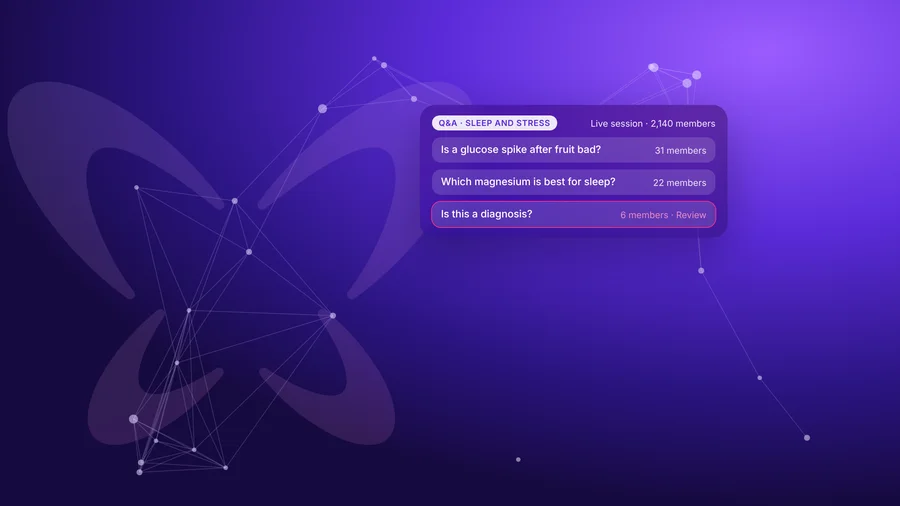
Put them in front of an audience, in the room and online. A recorded interview borrows credibility once. A session where members ask the sleep physician their own question, at an in-person event or a live digital one, builds it, and tells you what your members actually don't understand.
Turn one appearance into many messages. A one-off session is one message, to the people who turned up. The same hour, cut into clips, published on demand, written up as an FAQ from the questions and followed by a note from the expert, becomes a month of messages for everyone who didn't.
Pair the expert with the member. The trust data says people want the clinician and the person like them. Program both, deliberately, and let them agree on camera.
Measure the questions people ask. The questions members ask a doctor are the cheapest product research you will ever run.
Keep it all in a system of record. Expert video only becomes an asset if you can find it, check what was said, see who consented to what and use it again. Every session, in person or online, should land in one place with its recording, transcript, questions, approvals and consent, so the next campaign starts from what you already have instead of from zero.
Every session you keep can be searched, reviewed and reused years later.
Deep dive 01
Nothing the companies in this piece are doing is cynical. They are repeating something old, for a new audience, faster than the rules can catch up. Health tech will keep hiring the doctors. The open question for the next few years is whether it learns, before the first fraud alert, what pharma took three decades to learn about how to use them.
Frequently asked questions
Why are health tech companies working with doctors and scientists?
Because trust in health runs through clinicians. Edelman's 2025 health report found 82% of people trust their doctor to tell the truth about health, and doctors influence health decisions for 86%. A wearable that wants to talk about sleep, hormones or bloodwork borrows that trust by putting credentialed experts on its board and on camera.
What is the WHOOP Scientific Advisory Council?
A group of seven PhDs and MDs announced in October 2022, including Andrew Huberman, formed to guide research and product development and to contribute content to WHOOP's in-app coaching. In 2025 WHOOP added a separate Medical Advisory Board of practicing clinicians to shape its Advanced Labs bloodwork product.
What does the Oura Medical Advisory Board do?
Announced in November 2023, it is a nine-member board of sleep scientists, OB-GYNs, a stress researcher and others. Oura says the members contribute to member content, conduct research and advise on features.
How much more often do experts appear on the WHOOP Podcast now?
In our analysis of 395 episodes, 13% of episodes before the Scientific Advisory Council was announced had a credentialed clinician or scientist named in the title. Since then it is 31%, and in 2025 it reached 44%.
What can health tech learn from pharma speaker programs?
That borrowed credibility comes with rules. US drug and device companies reported paying nearly $2 billion for speaker-related services over three years before the OIG's 2020 Special Fraud Alert, and the PhRMA Code was tightened in 2022. Health tech is at the start of the same curve.




 Adelo Insights