

The voice in the car
Once a week I drive into London to our main office, and for most of the way I have Andrew Huberman or Michael Gervais in my ear. Huberman has given whole episodes to morning light and deliberate cold exposure. Over a few months of those drives, both moved from his episodes into my mornings. I now get outside into daylight soon after I wake, and I take a cold shower. Nobody prescribed either; I changed because someone I had come to trust walked through the reasoning, the studies and the caveats slowly enough that I believed it.
I am also a heavy user of AI for health. I ask it what a supplement does, whether a training block makes sense and what to make of a dip in my recovery score. The answers are quick and usually sound. And yet, when I trace the changes I have actually made back to their source, they lead to a voice, and the chatbot turns out to be where I went afterwards to check the detail.
That would be a private quirk if the way people find health information were standing still. It is moving faster than at any time since the search engine arrived, toward AI answers that arrive whole, with no list of links, and the person people trust is rarely in them yet.
This piece is about that gap. If AI is becoming the front door to health, and a trusted human voice is what moves people through it, every health brand has to decide who speaks when the machine answers. When AI answers become a commodity, the voice of a trusted expert becomes the most valuable thing a health brand can own, and the brands that matter will be the ones whose experts AI turns to.
The front door moves
About a third of American adults used AI for health information in the past year, according to a KFF poll published this spring.1 OpenAI says more than 300 million people a week now ask ChatGPT about their health, a figure the company reports itself.2 Even people who never open a chatbot are reading AI answers: in one study of more than 50,000 health searches in Germany, over four in five triggered a Google AI Overview above the links.3
The effect on the open web is measurable. Pew Research Center tracked the browsing of 900 adults and found they clicked through to a website on 15% of searches when no AI summary appeared and on 8% when one did.4 Researchers at the Indian School of Business and Carnegie Mellon went further, randomly assigning around a thousand people to use Google with or without AI Overviews for two weeks, and outbound clicks fell by close to 40%.5 That study has yet to be peer reviewed, but it points the same way as everything else. For a health brand, the website is becoming raw material for an answer someone else assembles, and the moment of decision happens inside that answer.
People are not entirely content with what they find there. KFF found that fewer than one in five AI health users were very satisfied, and more than half of those who asked about a physical problem went on to see a doctor.1 They use the machine to get their bearings, and when it matters, they still go looking for a person.
US adults used AI for health information in the past year (KFF)
people a week ask ChatGPT about their health (company-reported)
of searches end in a click, with and without an AI summary (Pew)
fewer outbound clicks with AI Overviews, in a randomized field experiment
What the machines reach for
The answer engines are already trying to give them one. Dartmouth researchers who audited nearly 2,000 health queries earlier this year found that the single most-cited source in Google’s US health answers was YouTube, ahead of Mayo Clinic, the CDC and the World Health Organization.6 Some of the most-cited channels belonged to health systems and others to general-interest creators. The authors called it a credibility vulnerability, because authority in AI health answers is being decided largely by YouTube’s own rankings.
We wanted to see what that looks like from a brand’s side. We took 45 questions people actually ask Google about supplements, training and recovery, drawn from its “People also ask” boxes, and traced every source behind the answers from Google’s AI Overviews and Perplexity.7 A few were gentle, like “Is HIIT hard for beginners?” Many were the kind you would want a professional to answer: “Is berberine like Ozempic?”, “Why do doctors say no to creatine?”, “Is there a downside to taking NMN?”
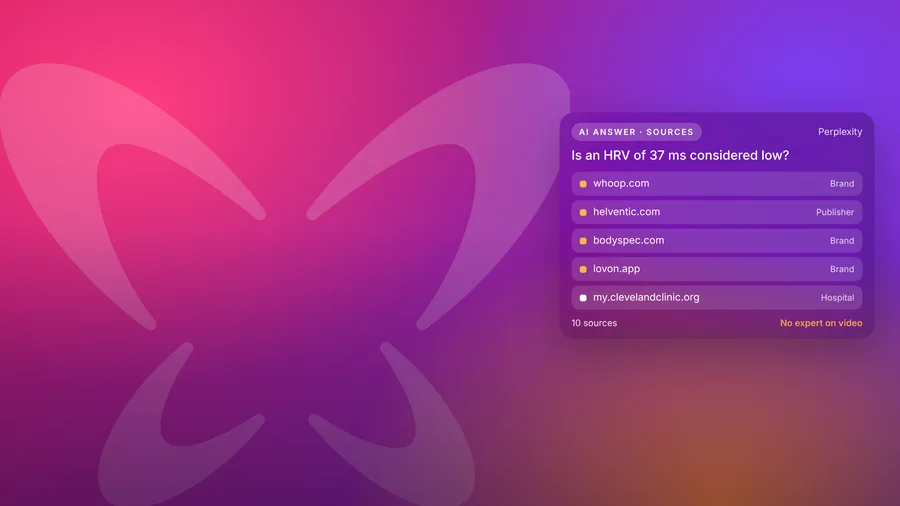
Across the 45, a brand’s own expert, a hospital’s or a clinician speaking from their own site appeared on video in the answer eight times. For the 29 questions where people most need a qualified person, about safety, what doctors think or how a supplement compares with a prescription drug, it was six. The rest of the time somebody else spoke for the category. Google showed a video in most of its answers, usually from an independent YouTube channel, some presenting physicians and physiotherapists and others personal trainers. On the NMN question, four of Perplexity’s ten sources were blogs written by companies selling NMN.
The detail that should change how brands think is who those other voices were. Across the 45 questions the engines cited 92 different brands, and 66 of them only once, usually a small site that had answered one specific question directly. The big names in supplements appeared once or twice each, and only through a video. Of the 140 questions in our wider list, 6% asked which product to buy, which is the question the new rankings of “brand visibility in AI” measure. The other 94% asked what something does, whether it is safe, or what a doctor would say, and on those questions AI authority is won one answer at a time, by whoever explains it best, with size counting for very little.
Only 8 of 45 health answers carried an owned expert on video
Adelo test of 45 questions on Google AI Overviews and Perplexity, 5 Nov 2026. Lit: the answer on either engine included a video from a brand, a hospital or health system, or a clinician’s own site. Hover a dot for the question.
It is a snapshot from a single day, and AI answers shift by person and place, but it points the same way as the Dartmouth work. The machines are reaching for expert video, and most health brands have yet to give them any.
Why a voice gets through
The reason the voice in my car changed my mornings is better understood than you might expect.
In 2015, Juliana Schroeder and Nicholas Epley at the University of Chicago ran a set of experiments in which people evaluated job candidates from the same short pitch, either read on the page or heard aloud. Those who heard it rated the candidates as more competent, thoughtful and intelligent, and were more inclined to hire them.8 A voice seems to carry evidence of a mind at work, in the pauses and emphasis of someone reasoning in real time.
Relationships add to the effect over time. Communication researchers have spent decades studying the one-sided bonds audiences form with hosts and on-screen figures, and a 2020 meta-analysis of 120 studies found those bonds are closely tied to persuasion.9 The bond builds over months of journeys with a voice you would come to recognize anywhere.
Health has its own evidence. A meta-analysis of 25 studies covering more than 9,000 people found that stories about health shifted attitudes, intentions and behavior when they were heard or watched, including the everyday preventive habits that sleep, exercise and supplements are made of.10
Format matters in a specific way too. In the 1970s and ’80s the psychologists Shelly Chaiken and Alice Eagly showed that video and audio put the speaker at the center of how a message is judged, which helps a credible, likable expert, while dense material lands better in writing, where people can take it at their own pace.11 The most persuasive package is a trusted person on camera, with the detail written down beside them.
Video alone is no magic trick, and the best recent evidence is careful on that point. A 2021 MIT study of more than 7,600 Americans found video more believable than a transcript of the same material, and only slightly more persuasive.12 The effect depends on who is speaking, whether you already trust them, and whether they reach you at the moment you are wondering.
There is a further ingredient the studies only half capture. When I listen to an elite coach or a sleep scientist, I am also hearing a version of myself: faster, stronger, more likely to be fit at seventy. Aspiration is what turns a correct answer into a changed morning, and it attaches to people.
When AI answers become a commodity, the voice of a trusted expert becomes the most valuable thing a health brand can own.Ben Randal
When answers are a commodity
Fluent health writing is becoming one of the cheapest things on the web. Graphite, an SEO firm, found that AI-generated articles overtook human-written ones in late 2024 and have hovered around half of new articles since, although people still wrote the large majority of the pages Google ranks and chatbots cite.13 When anyone can produce a competent paragraph on magnesium, the paragraph stops setting a brand apart.
A correct paragraph is also only part of what people need. In an Oxford study published in Nature Medicine this year, language models tested on their own identified the right condition in medical scenarios about 95% of the time. When ordinary people used the same models, they did no better than people using search or their own judgment, because they did not know what to ask or how to tell a good answer from a weak one.14 That is the skill a good expert brings on camera. They ask the question you did not think of, and they show you which part matters.
And the voices that do set people apart are already being copied. In 2024 the BMJ documented deepfaked videos of well-known British doctors, among them Hilary Jones and the late Michael Mosley, promoting products for blood pressure and diabetes. Jones now pays a specialist to find them, and they keep coming back under new names.15 A recording of a real expert, made with their consent, dated and kept by the organization that made it, is proof of who said what, and its value rises as everything around it gets easier to fake.
The expert record
Imagine a runner a few months from her first marathon. Her watch has shown poor recovery three days in a row, and late one evening she asks her AI assistant why. The answer that comes back is a sports physician she has listened to before, explaining in about ninety seconds what heavy training does to sleep and what to do about it. If she wants more, she can go to the whole conversation he was part of. She takes the next day easy, her numbers recover by the end of the week, and she remembers who told her.
Nothing in that scene is far-fetched, but almost no health brand is ready for it. It needs what I have started calling an expert record: a brand’s experts on video, recorded with consent, reviewed and kept in one place, organized so that an AI can find the minute that answers a question and play it with its context. I think of it the way a hospital thinks of a patient record or a lawyer thinks of a signed contract. It has a speaker, a date and a history, and that is what lets it be found, cited and trusted.
This is AI used to amplify people. The expert does what people do well, reasoning out loud, noticing the question behind the question and giving you something to aim for, and the machine finds the right ninety seconds in thousands of hours at the moment somebody asks.
I see it arriving in two moves, and the first is within reach today. A brand’s own site becomes the place to ask: someone types their question on an education page and gets a short written answer alongside the clip of the expert who gave it, and if they want the full reasoning, they can go to the whole session. Every question asked there also tells the brand what its customers need explained.
The second move is bigger. In March, Shopify made its merchants’ products shoppable inside ChatGPT. The model finds the right product through Shopify’s catalog, and the checkout and the customer stay with the merchant.16 Expert knowledge needs the same arrangement. When a brand’s expert record can be queried directly, a frontier model can ask it for the moment that answers a question and play it, with the speaker, their credentials and the date attached, while the full session and the relationship stay with the brand. In our test, the models found a brand’s own expert on video for 8 of 45 questions, and a catalog of approved expert moments is how that number changes.
Each move runs on the archive built before it, which is why the brands that start recording now will be hard to catch.
One expert record, served on your site today and inside AI assistants next
Adelo. A conceptual model of the two moves described above.
Why the honest brands win
There is a bigger reason I care about this. People are bombarded by health brands, and too many of them sell snake oil: big claims, thin evidence and a confident voice. Our test caught it in miniature. Asked whether there is a downside to taking NMN, Perplexity drew four of its ten sources from companies selling NMN. The deepfaked doctors in the BMJ’s investigation were selling in the same way, with a borrowed face and a promise.
When experts are used properly, grounded in science, the picture changes. A product that works, is safe and is worth the money has the most to gain from a qualified person explaining it in public, evidence and caveats included, and a product that relies on hype has the least, because a credible expert speaking on the record, with their name, credentials and date attached, has their own reputation at stake and tends to say only what they can defend. Put real experts in front of customers, on the record, and the best products rise on efficacy, safety and value.
Trust builds between a customer and a brand over time, as the brand keeps acting in the right way: choosing credible experts, letting them say what the evidence supports, and standing behind it. An expert record makes that conduct visible and lasting, and AI makes it findable at the moment someone needs it.
How a health brand gets into AI answers
The industry has started calling this answer engine optimization, and for a health brand most of it comes down to one habit: run expert webinars around the questions your audience asks, keep the recordings in one governed library, and publish each answer as a clip with a written page that names the expert. The full answer, in the form we recommend, is in Fig. 3 below.
Most health companies already produce this material and then lose it. Webinars, advisory boards, masterclasses, launch events and congress symposia happen every month, and most of them end up as a file nobody opens again.
- Know the questions. Write down the 50 or 100 questions your audience takes to AI, ask them yourself, and see who answers.
- Record far more, and record everything. Run expert sessions often, planned around those questions (our guide to running a webinar covers the production side). Record the in-person events as well, because some of the best expert moments a company has happen in a room and vanish when it empties.
- Keep it in one place, properly. Put every session in a single library, with its transcript, its chapters, the questions the audience asked and how people engaged, all searchable by question. Govern it from the start, with consent before recording, medical and legal review, and checks for adverse events and off-label claims; our compliance guide is the starting point. That library is your expert record.
- Make the answers findable. Cut the moments that answer real questions, give each one a page on your own site with the expert’s name, credentials and date, and publish to YouTube with a link back. Then watch what people ask, because those questions are the brief for what you record next.
Our own answer, built the way we recommend
How can a health brand get its experts into AI answers?
Run expert webinars built around the questions your audience asks. Each session reaches people live and leaves behind a bank of recorded answers that AI engines can draw on. Keep every recording in one governed library, and publish each answer as a short clip with a written page that names the expert, their credentials and the date. Text-first engines such as ChatGPT and Perplexity read the page, Google often shows the clip, and people act on advice from a person they trust.
CEO of Adelo · LinkedIn
- The question, in the words people actually type
- The answer first, in two or three sentences an engine can quote
- Who is speaking, named, with the credentials that make them worth hearing
- The expert on video, with the transcript and other data attached so engines can read it
- Where and when it was said, so the answer keeps its context
- The evidence and the way in, sources plus the full session
Adelo. The text above is our answer to the question this article is written for. Slot 4 shows what sits under the expert on a live brand page.
Consumer health, wellness and health tech brands can do all of this in public. Prescription-medicine brands in the UK and Europe will keep their libraries behind a login for healthcare professionals, with the same structure underneath.
Back on the road
Next week I’ll be on the road into London again, with someone in my ear explaining something I didn’t know I needed to hear, and afterwards I’ll probably ask an AI about it. What I want, and what I suspect most people will come to expect, is for those two things to meet: a machine that finds the answer, and an answer that is a person worth trusting. The health brands that build their expert record now will be the ones speaking when that happens.
Frequently asked questions
How can a health brand get its experts into AI answers?
Run expert webinars built around the questions your audience asks. Each session reaches people live and leaves behind a bank of recorded answers that AI engines can draw on. Keep every recording in one governed library, and publish each answer as a short clip with a written page that names the expert, their credentials and the date. Text-first engines such as ChatGPT and Perplexity read the page, Google often shows the clip, and people act on advice from a person they trust.
Why isn't my health brand showing up in AI answers?
AI answers are won question by question. In Adelo's test of 45 health questions, 92 different brands were cited and 66 of them only once, often small sites that answered one specific question directly. Big brands mostly appeared only through expert videos. A brand that has not published a direct, credited answer to the questions people ask has nothing for the engines to cite.
What content do AI engines cite for health questions?
Mostly hospital and government pages, health publishers and brand pages, plus YouTube on Google. A Dartmouth audit found YouTube was the most-cited source in Google's US health AI answers, ahead of Mayo Clinic, the CDC and the WHO. ChatGPT and Perplexity rarely cite video and rely on written pages.
Does video help a health brand in AI search?
Yes, in two ways. Google's AI Overviews showed a video in 24 of 39 health answers in Adelo's test, and people trust and act on an expert they can see and hear. Because ChatGPT and Perplexity mostly read text, each clip also needs a written page with the transcript, the expert's name, credentials and date.
What is an expert record?
An expert record is a health brand's experts on video, recorded with consent, reviewed and kept in one place, and organized so an AI can find the moment that answers a question and play it with its context. It has a speaker, a date and a history, so it can be found, cited and trusted.
How will AI assistants use expert video in future?
The likely path mirrors what Shopify did with ChatGPT, where a merchant's catalog feeds the model and the customer relationship stays with the merchant. A brand's expert record, queried directly, would let an AI play the exact moment an expert answers a question, with the speaker, credentials and date attached, and link back to the full session on the brand's own site.
How should pharma brands approach AI search?
In the UK and Europe, prescription-medicine brands cannot promote to the public, so their expert record faces healthcare professionals and sits behind a login, with the same structure of clips, transcripts and governance. Consumer health, wellness and health tech brands can publish in public.
How many people ask AI about their health?
About a third of US adults used AI tools for health information or advice in the past year, according to KFF, and OpenAI reports that more than 300 million people a week ask ChatGPT about their health.

Ben Randal is CEO of Adelo. LinkedIn
Sources
- KFF (2026). KFF Tracking Poll on Health Information and Trust: use of AI for health information and advice. Fieldwork Feb–Mar 2026, n=1,343.
- TechCrunch (2026). OpenAI makes ChatGPT Health available to all US users. 23 July 2026. Weekly user figures are company-reported.
- Search Engine Journal (2026), on SE Ranking. Google health AI Overviews cite YouTube more than any hospital site. Industry study of 50,807 German health queries.
- Pew Research Center (2025). Google users are less likely to click on links when an AI summary appears in the results. 22 July 2025.
- Agarwal, A. and Sen, A. (2026). Field experiment on Google AI Overviews and outbound clicks. Working paper, June 2026; not yet peer reviewed.
- Zha, Y. and Chang, S. (2026). Audit of health AI Overviews across 12 countries. Dartmouth College. arXiv preprint 2609.06798.
- Adelo (2026). Test of 45 health questions from Google "People also ask" on Google AI Overviews (39 answers captured) and Perplexity (45), 5 November 2026; 706 cited sources coded by type, format and speaker. One run on one day; credentials taken from channel names. Dataset (CSV).
- Schroeder, J. and Epley, N. (2015). The sound of intellect. Psychological Science, 26(6).
- Tukachinsky, R., Walter, N. and Saucier, C. J. (2020). Antecedents and effects of parasocial relationships: a meta-analysis. Journal of Communication, 70(6).
- Shen, F., Sheer, V. C. and Li, R. (2015). Impact of narratives on persuasion in health communication: a meta-analysis. Journal of Advertising, 44(2).
- Chaiken, S. and Eagly, A. H. (1976; 1983). Communication modality as a determinant of message persuasiveness and comprehensibility; and of persuasion: the role of communicator salience. Journal of Personality and Social Psychology. Summarized in Stiff, Persuasive Communication, ch. 10.
- Wittenberg, C. et al. (2021). The (minimal) persuasive advantage of political video over text. PNAS, 118(47).
- Axios (2026), on Graphite. AI-generated writing and human authorship. 14 October 2026.
- Bean, A. M. et al. (2026). Reliability of LLMs as medical assistants for the general public. Nature Medicine. See also University of Oxford.
- BMJ Group (2024). Trusted TV doctors deepfaked to promote health scams on social media.
- Digital Commerce 360 (2026). Shopify brands become shoppable inside ChatGPT. 25 March 2026.
 Adelo Insights