Health tech is good at the first purchase. A ring, a glucose sensor, a supplement on auto-ship or a meditation app on the home screen is easy to start. The companies that keep their customers will do it by selling what the product is for, with a person people trust explaining it.
The Adelo teamAdelo Insights
Published 3 November 2026
An Adelo Insights essay on health tech and the expert voice
Most consumer health products are now subscriptions: the ring and its membership, the glucose sensor sold by the month, the protein or magnesium on auto-ship, the app with an annual plan. That moves the commercial question from "will they buy?" to "will they still care in month seven?" People don't renew for a sensor or a capsule. They renew while they believe it is helping them become someone fitter, calmer or longer-lived, and churn begins when that belief fades.
1
Why the second year matters more than the first sale
Rock Health's 2025 survey of 8,000 US adults found 46% own a wearable, and 59% of owners wear it always or almost always.1 The CDC found 58% of US adults had taken a dietary supplement in the previous 30 days.2 Since 2024, people without diabetes have been able to buy a glucose sensor over the counter.3 Getting a product into someone's life is no longer the hard part; keeping it meaningful is. Research on tracker abandonment puts drop-off at 30 to 70% within months.4 Apps fare worse: across 93 popular mental health apps, median retention after 30 days was 3.3%.5 The reason people give is usually the same, that the product stopped feeling useful.
46%
of US adults own a wearable (Rock Health)
58%
took a dietary supplement in the past 30 days (CDC)
3.3%
median 30-day retention across 93 mental health apps
82%
trust their doctor to tell the truth about health
2
More data won't fix it
It is tempting to answer churn with more product: a new score, a new biomarker, a new insight card. The evidence says that is not enough on its own. Trackers do help. A 2022 umbrella review in Lancet Digital Health, covering almost 400 studies and 164,000 people, found they add about 1,800 steps a day on average.6 But a number gives feedback, and feedback is a different thing from a reason to keep going.
The most striking evidence comes from the IDEA trial, published in JAMA in 2016. John Jakicic and colleagues followed 470 young adults through a weight-loss program for two years. Half were given a wearable on top of the program. They lost less weight: an average of about 3.5 kg, against about 5.9 kg for the group that had the program alone.7 The wearable worked as designed, and the program assumed it would supply the motivation.
Personalized nutrition shows the same pattern from the other side. In ZOE's 2024 randomized trial in Nature Medicine, 347 adults on its personalized program cut triglycerides and weight more than those given standard dietary advice over 18 weeks. The authors also point out that the program group had more contact than the control group.8 The results that hold up tend to come with people attached.
Fig. 1The IDEA trial
Adding a wearable didn't add results
Jakicic et al., JAMA, 2016
3
People buy an aspiration
Psychology has a well-tested account of why some habits last and others don't. Self-determination theory, set out by Richard Ryan and Edward Deci, says lasting motivation depends on three things: autonomy, the sense that you chose this; competence, the sense that you are getting better; and relatedness, the sense that you belong with others doing it too.9 A wearable, a glucose sensor or a test kit is very good at the second. It tells you, precisely, whether you are improving. It does almost nothing for the first and third.
So the companies doing best talk less about metrics and more about aspiration, and longevity is the clearest case. WHOOP frames its product around healthspan, and its podcast has run episodes on the metrics that make up your healthspan.10 Function Health, which says it has run more than 50 million lab tests since 2023, sells regular bloodwork as a way to live longer and better.11 Nobody is buying an HRV reading, a lipid panel or a magnesium dose for its own sake. They are buying the chance to be strong and sharp at 70, and each number matters because of where it points.
What people need to keep going
What the device gives
What an expert and a community give
Autonomy: "I chose this"
Settings and goals
A reason that is theirs: the life they want at 70
Competence: "I'm getting better"
Precise feedback, every day
What good looks like, and what to ignore
Relatedness: "I belong here"
Very little
A face they trust and a room of people on the same path
Fig. 2The ladder
How an expert turns a reading into a reason
Adelo Insights
4
What experts can and can't do
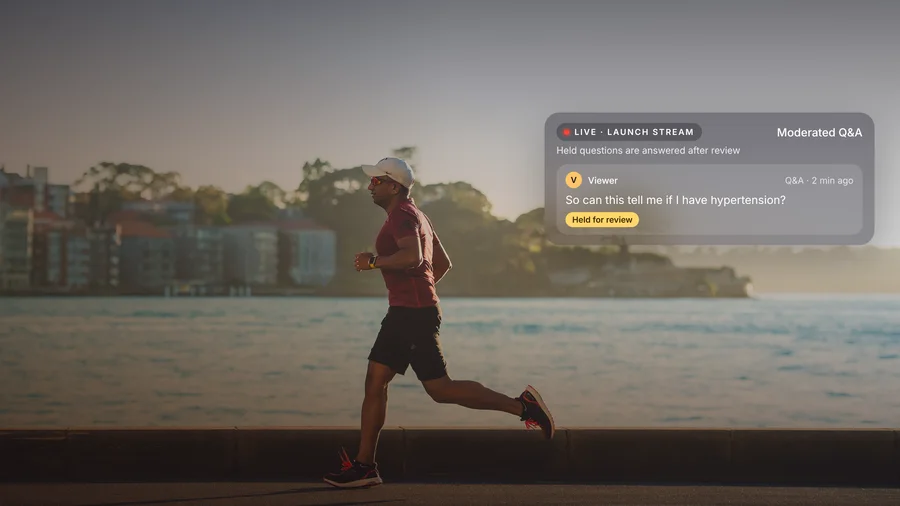
No expert can explain every customer's numbers. There are too many customers and too many numbers, and most wellness companies shouldn't be offering individual medical interpretation in the first place. Experts hired to explain the dashboard end up answering the same three questions on repeat, and nobody is much better off.
They are far more useful explaining the destination. A sleep physician who explains why deep sleep matters for the brain as we age, and what normal variation looks like, gives every customer a frame for their own data. A dietitian who explains why protein matters more after 50 makes a supplement subscription feel like a plan rather than a habit. A psychologist who describes what a realistic first month of meditation feels like keeps people past the week when most give up. And because trust in health runs through clinicians, with 82% of people trusting their doctor to tell the truth about health in Edelman's 2025 report, the expert gives the aspiration a credibility the brand can't supply on its own.12
Peloton's monthly churn for connected fitness subscriptions was 0.61% in fiscal 2021.
Peloton Form 10-K, 2021
5
Why live video works for this
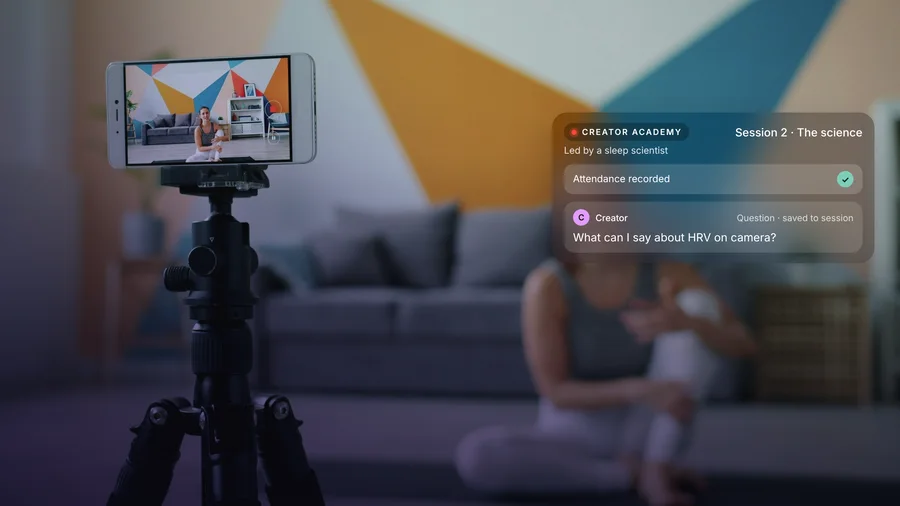
An aspiration is an emotional thing, and it travels best through people. Seventy years ago, sociologists Donald Horton and Richard Wohl described "intimacy at a distance": the one-sided relationship audiences form with people who speak to them directly on screen.13 Every successful health creator since has run on it. A clinician who looks into the camera and talks to you about your sleep feels closer than an article ever can.
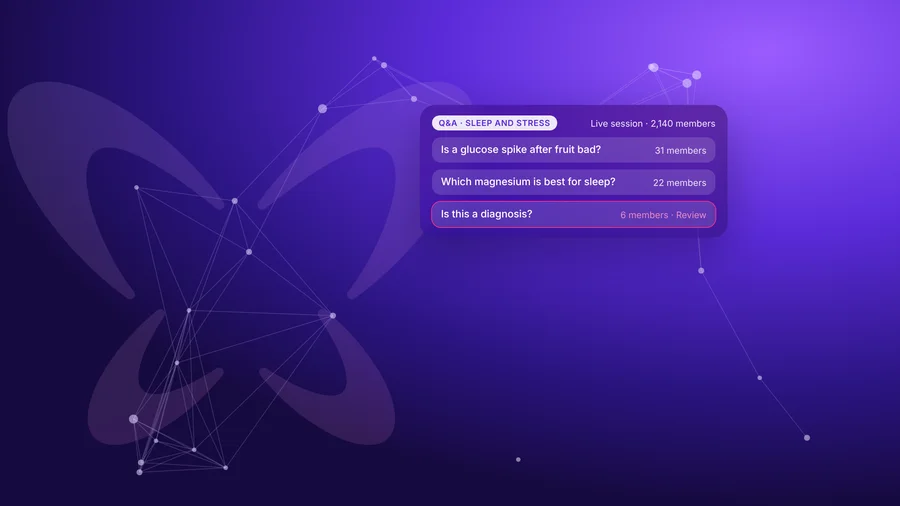
Live adds two things a recording can't. You are there at the same time as hundreds of other people on the same path, and you can ask your own question and hear it answered. Video also helps people learn: a 2021 systematic review of 105 studies found that adding video to existing teaching led to strong learning benefits.14 The recording then keeps working, as an on-demand library and as short clips that can sit right next to the metric they explain.
Fig. 3The loop
How a live expert program keeps members
Adelo Insights
6
What Peloton learned about people on screens
The clearest commercial proof of this idea comes from outside health tech. Peloton sells exercise equipment, but its business has always been the subscription, and its filings are blunt about why people keep paying: "our instructors play a critical role in bringing the Peloton experience to life," and members "feel connected to our instructors."15 In fiscal 2021, average net monthly churn for its connected fitness subscriptions was 0.61%, after 0.62% and 0.65% in the two years before.15 Some of that is the cost of the bike sitting in the spare room. Much of it is a person on a screen, at a set time, saying your name in a class you chose to join.
Health tech companies have the data Peloton never had, and most of them have no one on the screen. They should put the expert at the center of the subscription, on a schedule, with the data in a supporting role.
7
What a live program is worth
Finance teams rarely fund a content program on conviction alone, so it helps to put numbers on the idea. The model below is illustrative, with assumptions you can replace with your own. It takes 100,000 members paying $30 a month, assumes 20,000 of them attend at least one live expert session in a year, and gives those members a monthly churn of 2.5% against 4.0% for everyone else.
Fig. 4The model
How a lower churn rate among attenders adds up over a year
Illustrative model with stated assumptions; not measured data
On those assumptions, 74% of attenders are still paying after twelve months, against 61% of members who never joined a session. That is about 2,500 more paying members, worth roughly $0.9 million a year in recurring revenue, before counting what the sessions teach the product team. The way to test it is cheap: track renewal for members who attend a live session against a matched group who do not, and let your own numbers replace these.
8
What this looks like in practice
Pick the aspirations your customers actually have. Living longer, sleeping well, steady energy, menopause, training into later life. Their questions will tell you which.
Give each one a named expert and a monthly live session. A bench of three or four trusted voices beats a long list of one-off guests.
Let people ask. Questions make the session feel personal, and they tell you what your product isn't explaining.
Put the clips where the data is. Sixty seconds of a sleep physician next to the sleep score, or a dietitian next to the reorder button, does more than a help article.
Measure it like a feature. Compare renewal among customers who joined a live session with those who didn't.
The health tech companies that win the next five years won't be the ones with the most sensors, tests or ingredients. They will be the ones whose customers can say, without thinking, what the product is helping them become, and name the person who convinced them it was possible.
Frequently asked questions
Why do people stop using wearables and health apps?
Research on tracker abandonment puts drop-off at 30 to 70% within months, and a study of 93 popular mental health apps found median 30-day retention of 3.3%. The data or the content stops feeling useful because it was never connected to something the person wanted.
Can experts fix churn in health tech?
Not by explaining every number. Experts are most powerful when they make an aspiration credible, such as living longer, sleeping well or training into your sixties, and show how the data serves it. That gives each number a story.
Why use live video for health tech experts?
People form one-sided relationships with experts who speak to them directly on screen, what researchers call intimacy at a distance. Live sessions add the sense of being there with others and the chance to ask a question, which builds trust that a blog post cannot.
Are AI health coaches enough?
AI can answer instantly and at scale. But trust in health still runs through clinicians: 82% of people trust their doctor to tell the truth about health. The pattern that works is AI for the instant answer and a named expert for the reason to believe it.
Adelo Insights are written by the Adelo team, the professional video event platform for health. They draw on the sessions pharma, agency and consumer health teams run on Adelo every week, and on the research cited in each essay.




 Adelo Insights · Health tech and the expert voice