

The dashboard question
Most weeks someone shows me a dashboard. It tracks how often ChatGPT or Google’s AI names their brand when you type “best magnesium supplement” or “best fitness tracker,” and the number is usually lower than they would like. A whole industry of AI visibility tools has grown up around that number, and I understand the appeal. It looks like the old search rankings, and it fits on a slide for the board.
I think it measures the wrong question. Last week we pulled the 140 questions Google shows in its “People also ask” boxes around supplements, training and recovery, the questions people type when something is on their mind.2 Eight of them asked which one was best: the best iron supplement, the healthiest protein powder, the best form of collagen. The other 132 asked what something does, whether it is safe, what a doctor would say, or what the number on their wrist means.
We then took 45 of those questions, put them to Google’s AI Overviews and to Perplexity on the same day, and coded all 706 sources behind the answers by who published them and in what format.1 What came back describes a different contest from the one the dashboards track. It is about who AI lets explain things, it has different winners, and most of it is still open.
What makes people ask
People turn to AI because something caught their attention: a clip on Instagram, a comment from a friend, a number on their watch, a thought they can’t shake. When we sorted the 140 questions by what seemed to prompt each one, nine triggers covered all of them.
The largest group was curiosity with a practical edge: what ashwagandha does to the body, how long to sit in a cold plunge, how far 10,000 steps is in miles. Two in five questions were like that. Safety came next, with about one in six: why be careful with ashwagandha, what the risks of cold plunging are, whether a daily iron supplement is safe. Then the body, with questions like “Why do I feel exhausted the day after a workout?” Smaller groups asked about a goal, about a medicine, about a rule they had seen online, and about their own numbers from a watch or a ring.
Eight of 140 health questions asked which one is best
Adelo analysis of 140 questions from Google “People also ask” for supplements, training and recovery, November 2026. Each question is coded to the one trigger that best explains it.
The order matters for anyone deciding what to publish. A brand that writes only for the moment of purchase is writing for eight questions in 140. The other 132 are where people form a view of a category, and of who in it deserves their trust, long before they reach a product page.
Who explains it now
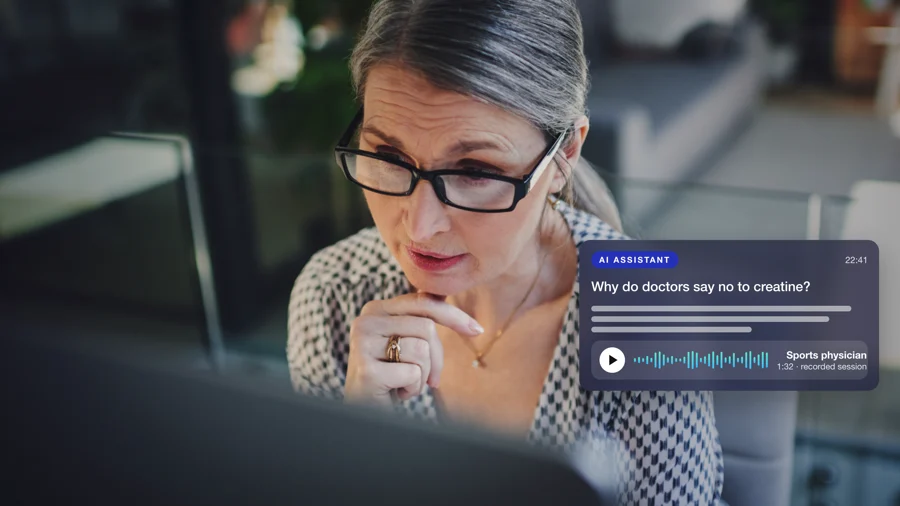
Institutions answer most of those 132 today. Hospitals, universities and government health sites supplied 262 of the 706 sources, over a third of the total, and a handful did much of the work. Cleveland Clinic alone was cited 35 times, followed by PubMed Central, Harvard and Mayo Clinic. On the questions framed around doctors, such as “Why do doctors say no to creatine?”, institutions supplied almost two-thirds of the sources.
Brands supplied 134 sources, about one in five, and the way they were spread surprised me. Across the 45 questions the engines cited 92 different brands, and 66 of them appeared exactly once. AI hands out authority one answer at a time, to whoever has published the most direct reply to that specific question, and very few brands have published more than one.
sources behind 84 AI answers to 45 health questions
different brands cited across those answers
of those brands cited only once
Google AI answers included a video
The small sellers’ advantage
When we grouped the brands by size and type, the result ran against instinct. Small and specialist sellers, companies most marketers in the category would not recognize, appeared in the answers to 22 of the 45 questions. Established consumer brands appeared in 13, emerging health tech companies in 11, and clinics in 6.
Small sellers reached more health answers than established brands
- 22of 45
Small and specialist sellers
36 brands, 48 citations. Rep Fitness, Squatwolf, Jinfiniti, nmn.com
- 13of 45
Established consumer brands
22 brands, 37 citations. Garmin, Apple, Nike, REI, Walgreens
- 11of 45
Emerging health tech
26 brands, 41 citations. WHOOP, Oura, Ultrahuman, Welltory
- 6of 45
Clinics and practitioners
8 brands, 8 citations. Physio clinics, functional-medicine practices
Adelo test of 45 questions on Google AI Overviews and Perplexity, 5 November 2026. Count of questions where at least one source on either engine came from a brand in each group. Dots show the 45 questions.
The sellers won by being specific. On the 3-3-3 rule for running, a viral training shortcut, the sources were small fitness brands and two physiotherapy clinics. On whether there is a downside to taking NMN, four of Perplexity’s ten sources were companies selling NMN. What they had in common was a page that answered the question in its first paragraph.
Size helped where a big brand had published that page. Garmin supplied six of the sources for “What is a good VO2 max for my age?” across both engines, because it publishes VO2 max ranges by age. WHOOP appeared on both engines for both of the heart rate variability questions we tested, and Apple’s support pages answered whether an Apple Watch can measure VO2 max. Outside those questions the big names were thin on the ground. Some of the best-known supplement brands appeared once in the whole test, and only by way of a video.
Your own numbers
Some of the most open questions in the test came from people looking at their own data. “Is an HRV of 37 ms considered low?” “What is a good VO2 max for my age?” “Can Apple Watch measure VO2 max?” These are people who wear a ring or a watch and wake up to a score. Across the seven such questions we tested, hospitals and universities supplied about a fifth of the sources and brands supplied nearly half. Google put a video in 24 of its 39 answers across the test, yet for these seven questions there was no video for it to show: nobody had recorded one.
A number on your wrist is exactly the kind of thing you want a person to interpret: whether it is normal for you, whether to worry, what to do tomorrow. The brands answering today mostly do it with charts and ranges. A health tech company that put a clinician or a coach on camera to explain what a low HRV means, and what to do about it, would have that answer almost to itself.
A brand that writes only for the moment of purchase is writing for eight questions in 140.Ben Randal
Where the ground is open
To see the opportunity question by question, we gave each of the 45 an open-ground score from 0 to 100. It rises when no brand, hospital or clinician has its own expert on video in the answer, when fewer sources come from institutions, when more come from small sellers and forums, and when the answer cites no video at all. A high score means nobody with real authority has claimed the answer yet.
The most open questions are about wearable numbers, viral rules and medicines
Adelo test of 45 questions, 5 November 2026. The twelve highest-scoring questions and, below the line, the two lowest. Score: 40 points if no owned expert video appeared, up to 30 for a low share of institutional sources, up to 20 for a high share of small sellers and forums, 10 if no video was cited.
The closed end belongs to the doctors. “Why don’t doctors recommend CoQ10?” scored 8 and “Why do doctors say no to creatine?” scored 12, because hospitals and health publishers had those answers covered and, on three of the four doctor questions, someone’s own expert was already on video. The open end mixes wearable numbers, viral running rules and pre-workout safety with two questions about medicines: whether to take a probiotic with Macrobid, an antibiotic, and whether vitamin D is safe alongside diltiazem, a heart and blood pressure drug.
The medicine questions
Those last two deserve a moment for anyone in pharma. Six of the 45 questions involved a prescription medicine: which vitamins to take with omeprazole, whether berberine is like Ozempic, whether a probiotic is safe with Macrobid. The engines answered them mostly from drug reference and health publishing sites; Drugs.com alone supplied 12 sources across the six. Hospitals and universities supplied fewer than a third.
A medical information team answers questions like these every day, by phone and by email. In AI answers, almost no one who makes or studies the medicine is answering them on the record. A prescription brand in the UK or Europe cannot promote to the public, and nothing here suggests it should. Its scientists and medical affairs teams are still well placed to explain, in plain and non-promotional terms, how a medicine sits alongside the supplements patients take, and the question will be answered by somebody either way.
How a brand owns a question
Owning a health question is a publishing job. The brands that showed up in our test had done three things, often without meaning to. They answered one question directly, near the top of a page, in plain words. They gave a reason to be believed, whether a chart, a study or a named expert. And they were where the engines look, on their own site and, for Google, on YouTube.
The strongest version of that is a credible expert answering on the record. People trust a person they can see and hear, and an expert with their name and credentials attached says only what they can defend, which is why honest, science-led products have the most to gain. Webinars are one of the most efficient ways to produce it. Plan a session around the twenty questions your audience is asking AI, let an expert answer them live, and you get reach on the day and a bank of answers afterwards: a clip for each question, with a written page beside it that names the expert, their credentials and the date. The first session gives you your first video. Every session after it adds to a library AI can draw on.
- Pick your questions. List the 50 to 100 questions your customers take to AI, ask them yourself, and note who answers.
- Start where the ground is open. Questions answered by small sellers, forums or nobody in particular are easier to win than those Cleveland Clinic already owns.
- Answer with a person. Record a qualified expert answering each question, cut a short clip, and give it a page with a transcript, their credentials and the date.
- Ask again in a month. Put the same questions back to the engines and see whose answer comes back.
Our test was one run on one day, on two engines and in English, and AI answers shift by person, place and time. Treat the numbers as a snapshot of the pattern. The pattern itself is consistent across the questions: the answers go to whoever has said something specific and believable, and most health brands have yet to say it.
Back to the dashboard
I don’t think brands should ignore the “which one is best” question. It is where money changes hands. It is also the last question in a long conversation, and by the time someone asks it they have usually decided whom they trust. The other 132 questions are where that happens, and in our test most of them were answered by a hospital, by a small seller with one good page, or by nobody in particular. That ground will go to whoever claims it first with something worth believing.
Frequently asked questions
Which brands does AI cite for health questions?
Mostly the ones that answered the exact question. In Adelo's test of 45 health questions on Google AI Overviews and Perplexity, the engines cited 92 different brands and 66 of them only once. Small and specialist sellers appeared in 22 of the 45 answers, established consumer brands in 13, emerging health tech companies in 11 and clinics in 6. Hospitals, universities and government sites supplied more than a third of all sources.
What do people ask AI about their health?
Mostly what something does and whether it is safe. Of 140 health questions from Google People also ask, 39% asked what something is or how to use it, 16% asked whether it is safe, 9% asked what their body was telling them, and 7% asked about their own numbers from a wearable. Only 8 of the 140 asked which product or option is best.
Can a small brand get cited in AI health answers?
Yes. In Adelo's test, small and specialist sellers appeared in more AI health answers than established consumer brands, usually because they had published one page that answered one specific question in its first paragraph.
Which health questions are easiest for a brand to win in AI answers?
Questions where no hospital, brand or clinician has its own expert on video, where few sources are institutions, and where the answer leans on small sellers or forums. In Adelo's test these included questions about wearable numbers such as HRV and VO2 max, viral training rules, pre-workout safety and supplements alongside medicines. Questions about what doctors say were the hardest, because hospitals and health publishers already covered them.
Is there room for expert video in AI answers about wearable data?
Yes. Google's AI Overviews included a video in 24 of 39 health answers in Adelo's test, but for seven questions about people's own numbers, such as HRV and VO2 max, there was no expert video for either engine to cite. A clinician or coach explaining what those numbers mean would face little competition.
How can a health brand get its experts into AI answers?
List the questions your customers take to AI and see who answers them. Start with the open ones. Run expert webinars built around those questions, then publish each answer as a short clip with a written page that names the expert, their credentials and the date. Ask the same questions again a month later to see whose answer comes back.
Should pharma companies answer medicine questions in AI search?
People already ask AI how supplements fit with their medicines, and in Adelo's test those answers came mostly from drug reference and health publishing sites. Prescription brands in the UK and Europe cannot promote to the public, but their medical and scientific experts can provide non-promotional information, and the question will be answered by someone either way.

Ben Randal is CEO of Adelo. LinkedIn
Sources
- Adelo (2026). Test of 45 health questions from Google “People also ask” on Google AI Overviews (39 answers captured) and Perplexity (45), 5 November 2026; 706 cited sources coded by source type, format and speaker, and brands grouped by size and type. One run on one day. Dataset (CSV).
- Adelo (2026). 140 questions from Google “People also ask” for supplements, training and recovery, collected November 2026 and coded by trigger.
 Adelo Insights