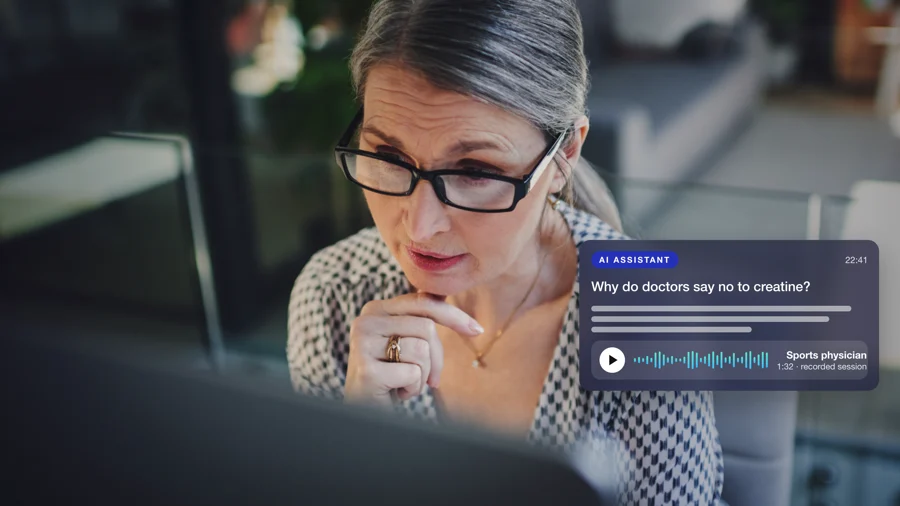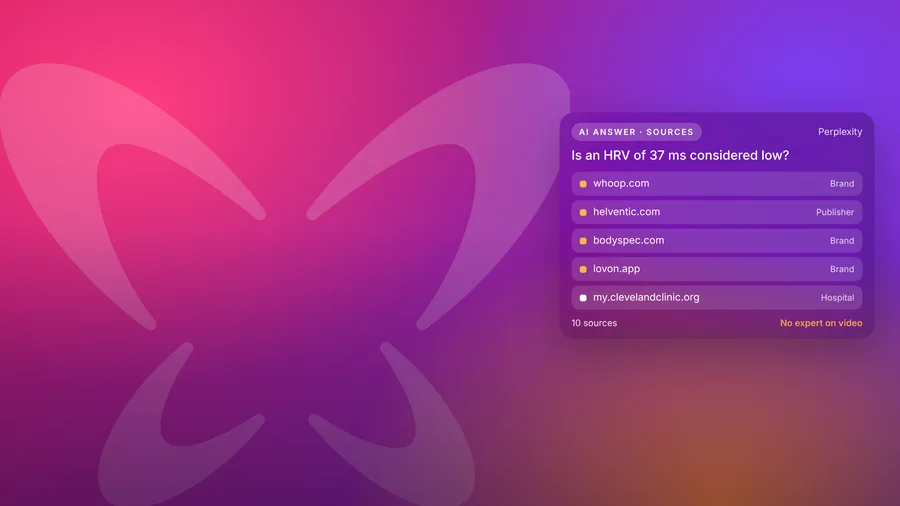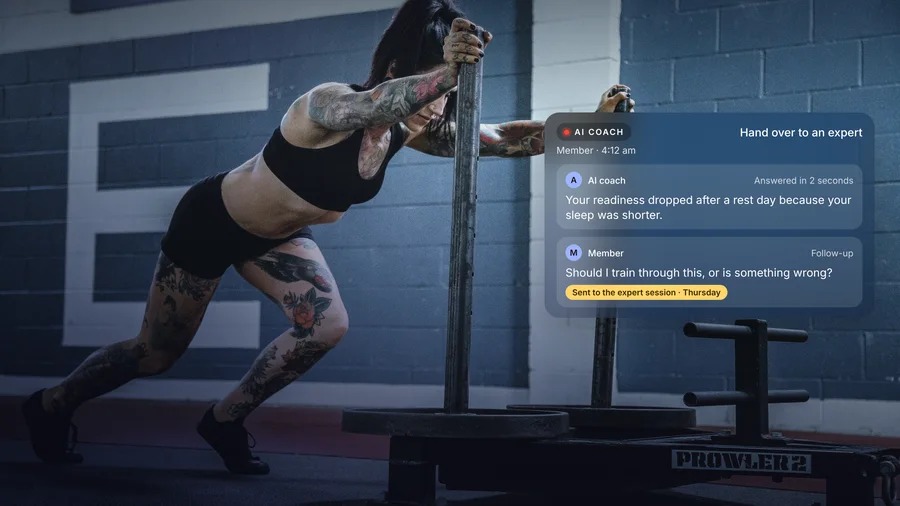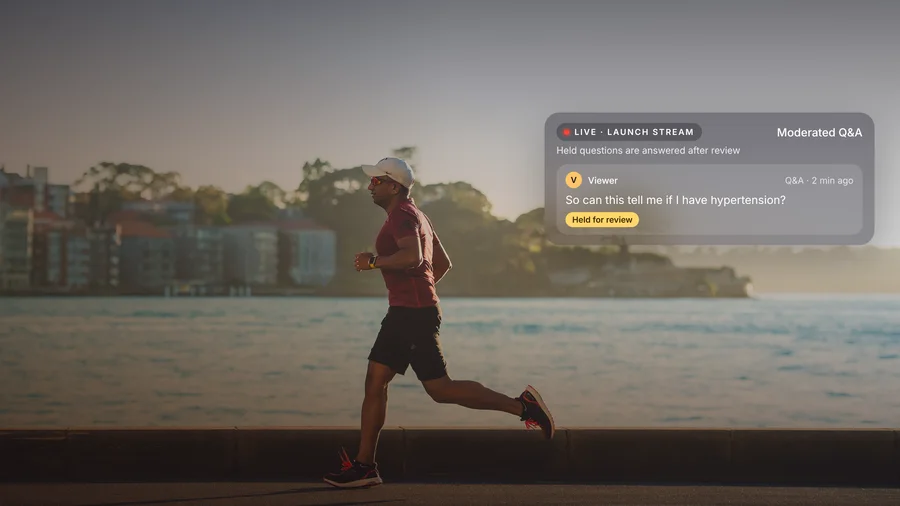


What does she get back?
It is twenty to eight on a Tuesday evening, and a woman eight weeks out from her first marathon is sitting on her kitchen floor with her running shoes still on. The long run went badly. Her legs went at mile nine, and she suspects it had more to do with food than fitness. She opens ChatGPT and types the question she has been meaning to ask for a month: what should I actually eat after a long run?
The answer arrives in seconds, and it is perfectly sensible. Carbohydrate and some protein soon after, plenty of fluid, a few example meals, a suggestion to talk to a professional if problems persist. She reads it, nods, and closes the app. By the weekend she has forgotten most of it.
I recognize that moment, because I live it most weeks, and regular readers will recognize her. In an earlier piece I imagined a runner like her hearing back from an expert, and argued that the changes people actually make trace back to a person they trust. A paragraph can tell you what to do, while a person you trust tells you which part matters for you, and why. This piece is about where her answer comes from.
What she needed that evening was a person: someone who knows runners, who could tell her what to do tonight and what to stop worrying about, in about the time it takes to unlace a pair of shoes.
Where are the answers already?
In this case, in a supplement company’s video library. Last spring the company ran an hour-long masterclass with a sports dietitian who explained recovery eating so plainly that people in the chat thanked her by name. Ninety seconds of it would have answered the question on the kitchen floor better than anything else on the internet. Nobody has watched the recording since the day it ended.
I see this everywhere. My working life has been about getting insight out of what experts and audiences say, and what has always frustrated me is how much of it disappears. If a company runs webinars, advisory boards, masterclasses and events, the answers to a great many of its audience’s questions have already been given, by the right person, on the record. They are sitting in files.
The investment behind them is real. When the US Office of Inspector General looked at speaker programs in 2020, drug and device companies had reported paying nearly $2 billion to clinicians for speaker-related services over three years.1 IQVIA, which sells content services to pharma, says a large share of the material produced for healthcare professionals is never used, and most of it never reaches a doctor at the moment of a clinical decision.2
I have started to think of every session as a deposit.
Most health companies have years of deposits and almost no way to make a withdrawal.Ben Randal
Why doesn’t anyone find them?
Because almost all of that video was made to be watched. A webinar, a conference session or a recorded event is built around a topic: an agenda, a run of slides, forty-five minutes on stage or on screen and a Q&A at the end. That works for the people in the room or on the call, and for the few who sit through the replay. It does nothing for the runner on the kitchen floor, who has one question and two minutes.
Clinicians are the same, only busier. Picture a rheumatologist with seven minutes between patients, wondering what the evidence says about dosing in patients over seventy-five. The best explanation anywhere is a medical education session a pharmaceutical company ran in March, in which two specialists walked through exactly that, about twenty minutes in. She will never find it by scrubbing through a recording. In Sermo’s 2025 research, 63% of healthcare professionals said they want short, bite-sized content that delivers fast facts, and 57% said they prefer videos under five minutes.3 In Graphite Digital’s 2026 survey, 55% of clinicians said they prefer to seek out information themselves.4
So the thing worth owning is the answer, and the hour is where it comes from. Take the ninety seconds in which the dietitian explains what to eat after a long run. Cut it cleanly, attach her name, her credentials, the date and the question it answers, and link it back to the full session for anyone who wants the rest. Do that across every session a company has run and it has a bank of expert answers that it owns.
One hour-long masterclass, and the ninety seconds someone needs
What should I eat after a long run?
Adelo. An illustrative example of one answer cut from a recorded session.
What else is in there?
Insight. The questions people asked, the polls they answered and the points where they pushed back tell a company what its audience is worried about, in their own words. Companies pay for research to learn that. Here it comes as a by-product of an event they were running anyway.
What the audience asked, and what they said they would do
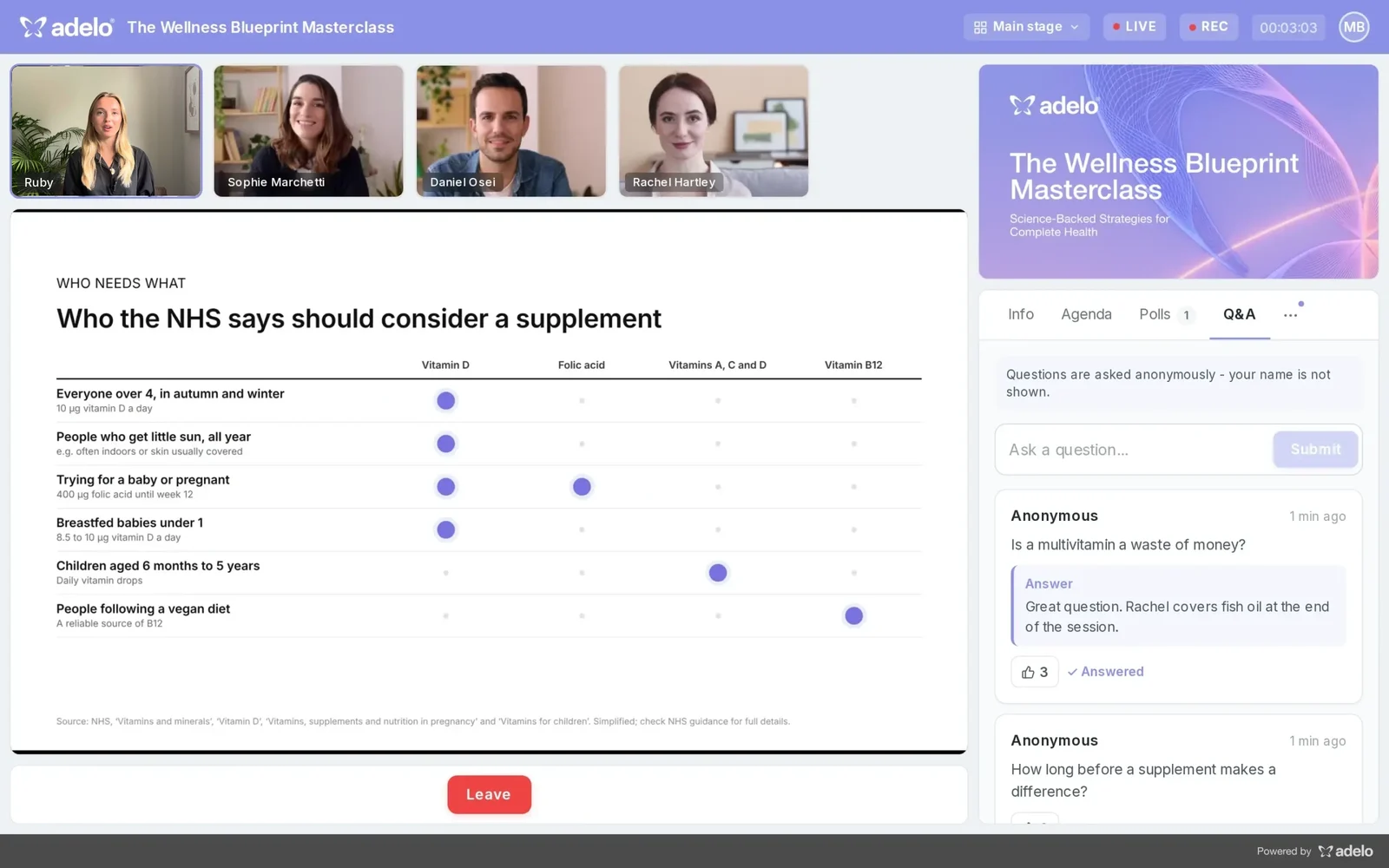

Adelo platform, demo workspace. Left: audience questions during a live session. Right: a poll result from a medical education session.
Kept across a year of sessions, that becomes a picture nobody else has: which questions keep coming back, which explanations landed and what the next session should cover. And one session can serve several audiences later. The dietitian’s hour holds answers for the runner and talking points for the company’s own customer team.
There is a quieter reason to keep it as well. Experts move on, and so do the people who ran the session. If what was said lives in their heads and their inboxes, it leaves with them. In a record, it stays with the company.
What does AI change?
It makes the content reachable. This material has always been valuable and it has always been out of reach, because nobody can search fifty hours of video for one answer. AI can. It can find the moment, pull out the answer and bring it to whoever asks, whether that is a colleague inside the company or someone typing a question into ChatGPT. To go back to the deposits, AI is how a company finally makes a withdrawal. The condition is that the content has been stored correctly, which I will come to.
It also changes what gets rewarded. For most of the last decade, the world has rewarded whoever grabbed attention, and health brands played by the same rules. Social platforms rewarded whoever posted most, whether or not they were right. When University of Chicago researchers reviewed popular sinusitis videos on TikTok, nearly 60% of those from non-medical influencers contained non-factual information, against 15% from medical professionals, and the influencers were still more visible because they posted far more.5 AI search has started to reward credibility instead. About a third of American adults used AI for health information in the past year, and they increasingly get an answer rather than a list of links.6
The engines reach for expert video when they assemble those answers. Dartmouth researchers who audited nearly 2,000 health queries found that the single most-cited source in Google’s US health answers was YouTube, ahead of Mayo Clinic and the CDC.7 In our own test of 45 everyday health questions, Google showed a video in 24 of its 39 answers, yet a brand’s, hospital’s or clinician’s own expert appeared on video in only eight.8 The engines want expert video, and most brands have not yet given them any of their own to use.
Google has even built for this. It lets publishers mark the key moments inside a video, so it can send someone straight to the part that answers their question.9 That shows where search is heading. But a timestamp only says where to look. It doesn’t say who is speaking, whether the answer was approved, or who is allowed to see it.
Video is only part of the pull, though. Google likes it, while ChatGPT and Perplexity lean on written pages, and in our test Perplexity rarely cited video at all.8 What every engine can use is the expert’s answer in words: the transcript, the speaker’s name and credentials, the date and the question it answers, sitting on a page beside the clip. Some of that sits underneath the video as tags that tell Google what the clip is and where each answer starts. The rest has to be on the page itself, where people and every engine can read it. So the asset is the answer, kept in both forms. People and Google get the person on camera, and the text engines get exactly what that person said, with their name on it.
Clinicians are moving the same way, through tools of their own. OpenEvidence, an AI tool that only verified US clinicians can use, told NBC News that about two-thirds of American physicians used it in April 2026, and an EPG survey found 54% of healthcare professionals using generative AI to look up scientific information.10, 11
of HCPs want short, bite-sized content (Sermo, 2025)
Google AI health answers included a video (Adelo test, 2026)
US physicians used OpenEvidence in April 2026 (company-reported)
US adults used AI for health information in the past year (KFF)
So AI works in both directions. It lets a company get at what it already has, and it sends the outside world looking for exactly what an expert session contains: a credible person answering a specific question, with their name and the date on it. I think of a well-kept bank as a magnet for these systems. A fair question is whether AI will use a company’s own answers at all. In our test it did. When we traced the 706 sources behind those answers, about one in five came from brands, 92 different ones, and small specialist sellers reached more answers than the established names because they had answered one specific question directly.8 An organization’s own expert on video rarely appeared, and I read that as an open field for whoever starts.
Why does this need a system of record?
Because AI can only reach what has been stored correctly, and today most of this content lives in a folder of video files. Finance has its ledger, sales has its CRM and hospitals have the patient record. If a company’s expert answers are going to be found, trusted and reused, they need the same thing: a system of record, one place where every session is kept with everything that makes its answers usable.
It also has to belong to the company. A recording that sits on a social platform or inside a webinar tool is mostly working for that platform. Kept in the company’s own record, the video, the transcript and the audience’s questions are its own data, and the company decides who sees them and where they go.
And the easiest time to store a session correctly is when it happens. Consent is given before someone speaks, and the questions are asked on the day. Those are hard to add a year later.
I think of that record as resting on three pillars. The first is compliance: consent captured before anyone speaks, moderated participation, review decisions, safety signals and an audit trail of who did what. The second is intelligence: what people asked, what they responded to and what still needs explaining, across one session or a whole program. The third is content: the clips, chapters, transcripts and summaries that turn an hour into answers. Take any pillar away and the bank stops working, because an answer you cannot trust, cannot find or cannot reuse is worth very little.
The first place AI helps is inside the record. A team should be able to ask a session, or a year of sessions, a question in plain language and get an answer that links straight to the moments it came from. That alone saves medical affairs and brand teams hours of hunting.
An answer that cites its moments, and a record of who looked
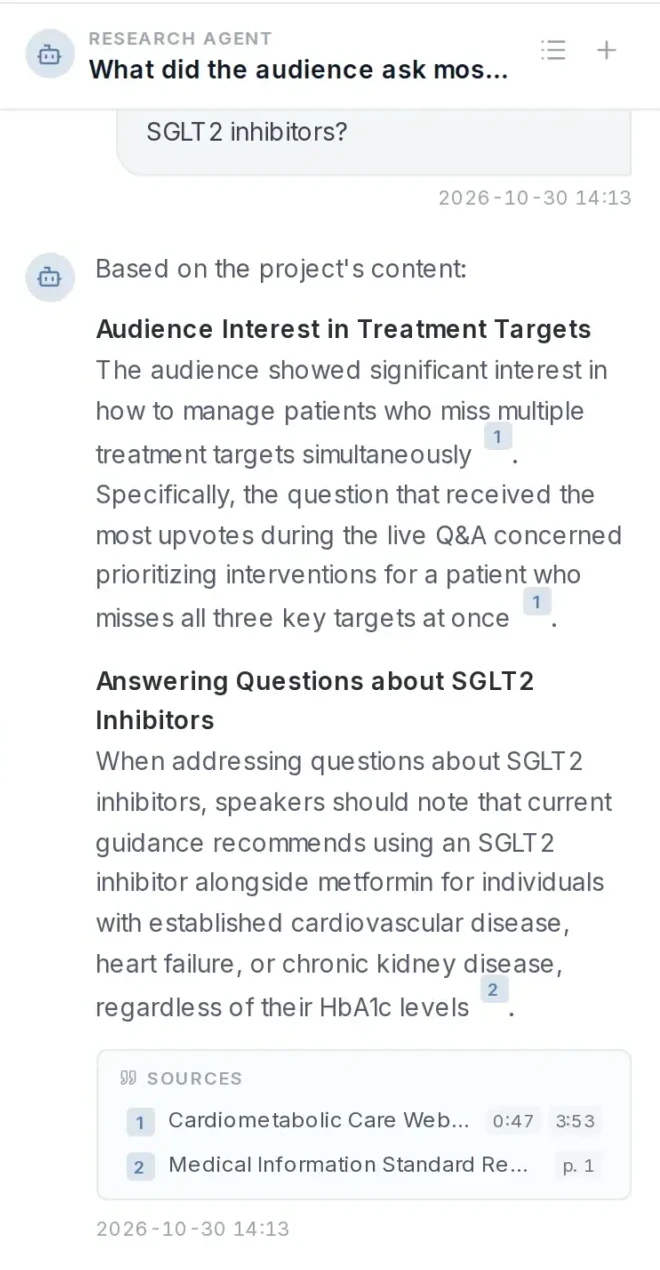
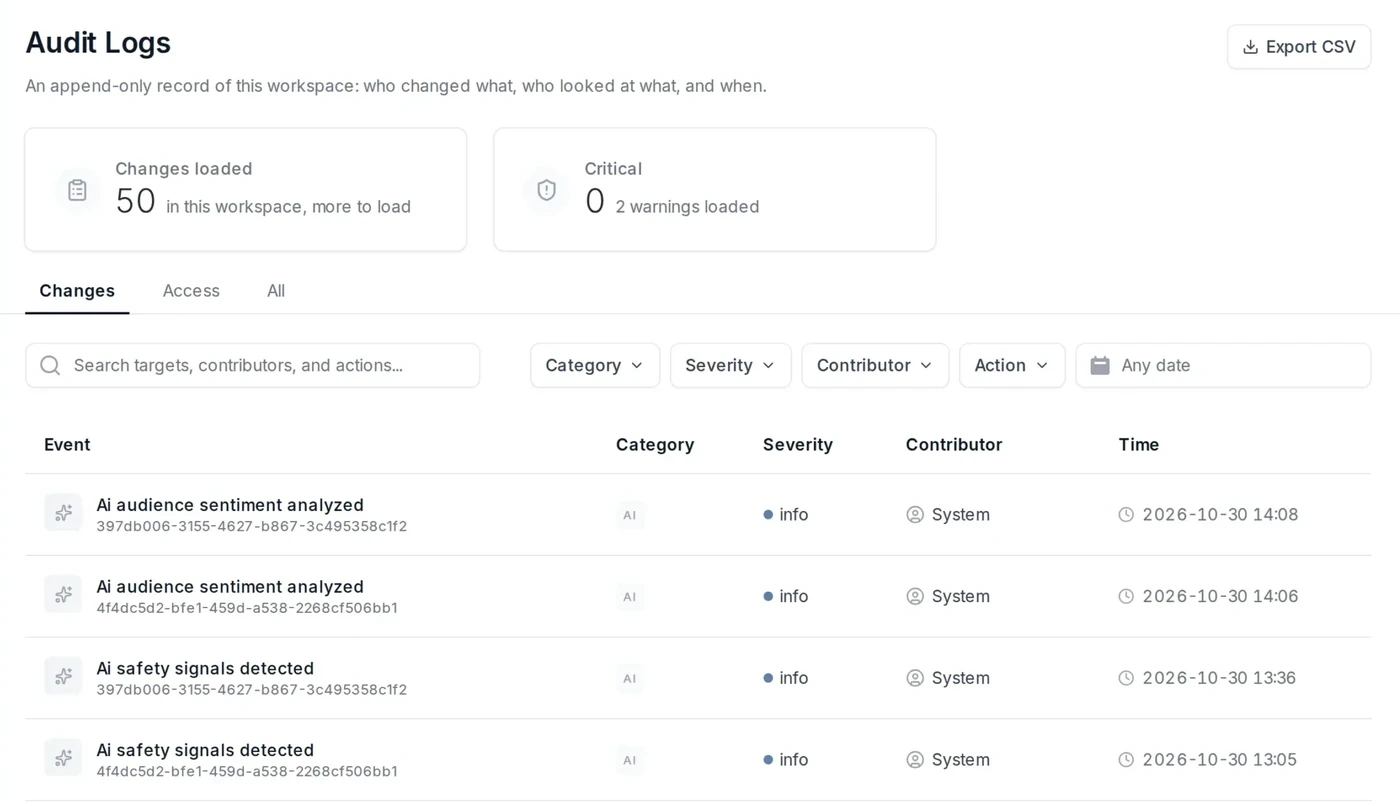
Adelo platform, demo workspace. Left: the research agent’s answer, with sources linked to the moment in the recording. Right: the audit log.
Then the answers have to get out of the record, to two places.
The first is the open web. Each approved answer can be published as its own page on the brand’s site, with the clip, the transcript, the speaker’s name and credentials, the date and the question it answers, and the tags underneath that tell Google what it is. When someone asks that question, this is the page an AI engine should land on, and it should find everything it needs without having to dig. The same pages make an “ask our experts” section a brand can put in front of its own customers.
The second is inside the company. A standard called the Model Context Protocol, or MCP, lets AI assistants connect to a company’s own systems and look things up directly, and OpenAI built the apps inside ChatGPT on it.12, 13 Plug the record in that way and the same governed answers can reach a medical science liaison’s assistant before a meeting, a brand team building a launch email or an agency writing its program report, without anyone hunting through files. That is why we are launching an MCP connection for Adelo, starting with Claude, so a team can ask its own AI assistant about its programs and get answers that come straight from the record.
In both cases the answers come from the same record and keep its rules, so what the public sees and what a colleague sees have been through the same approvals.
Sessions go in, and answers go out to the open web and to the company’s own AI tools
- Webinars
- Advisory boards
- Masterclasses
- Medical education
- Events and 1-to-1 sessions
Every session, every answer
AI inside the record: ask a session or a program, get answers linked to the moment
- Answer pages on the brand’s site
- AI search and answer engines
- Medical affairs assistants
- Brand and content teams
- Agency program reports
Adelo. A conceptual model of a system of record for expert video.
What makes an answer safe to serve?
There is one thing a health company has to get right before any of this goes out. Go back to the dietitian’s masterclass. A few minutes after her answer about recovery food, responding to a question about the company’s magnesium powder, she added a warm, off-the-cuff remark that it helps people sleep. The brand’s regulatory team would never have approved that line for an ad, and a careless tool fetching her answer could bring it along with her answer.
In health the expert is often the marketing, and the rules follow the expert’s words. In Sermo’s research, 72% of physicians said they were more likely to consider product information from a trusted KOL.14 Regulators know it: a UK advisory board run by Napp was found to be a promotional meeting, and the FDA has treated an interview as promotional and held it to the standards of an ad.15, 16 Consumer brands are bound too. Under the FTC’s Endorsement Guides a brand is responsible for what its endorsers say, and in Europe and the UK foods and supplements may carry only authorized health claims.17, 18
Inside the company the record raises other questions. A medical science liaison asking Copilot about this year’s advisory boards could pull up a recording in which a physician described a side effect in one of her patients, a potential adverse event that nobody has triaged. The rheumatologist’s medical education session may sit in the same library as a promotional webinar for the same medicine, with one of the same speakers.
None of this is new to the people who run these programs. They already decide what consumers can see, what clinicians can see and what stays inside the company. The record has to carry those decisions with every answer it serves.
- Each audience sees its own answers. Consumers see the public record, clinicians see the HCP record, and colleagues see what their role allows.
- The status travels with the answer. Consent, review, audience, claims and disclosures arrive attached to every clip.
- Only approved answers go out. Nothing reaches the public or clinicians until the people who sign it off have done so, and medical and promotional material stay apart.
- Safety signals go to people. A possible adverse event is flagged to the safety team, who decide what happens next.
- Every answer shows its source, and every request is recorded. The person can go straight to the full session, and the company can see who asked for what.
The point of a good record is that medical, legal and regulatory reviewers decide once, and every answer served from the bank, to a person or to an AI tool, respects that decision afterwards.
Where do you start?
With what you already have. Nothing in this argument asks a company to make more content, hire more experts or find a new audience. The experts have been paid and the sessions have been recorded. The questions the audience cares about are sitting in the Q&A of those sessions.
So start with one recording. Take the best session from the last year, list the questions people asked in it, and cut the answer to each. Have the people who would normally review it approve them. That review is real work, and it is the part worth doing once and keeping. Put each answer on a page with its transcript and the expert’s name. That is a first set of answers the brand owns, and a way of working every new session can follow. The sessions still to come are the easiest to get right, because consent and questions can be captured as they happen.
The cost of waiting is easy to describe. The company keeps paying for the expert, fills the room once, and the next time someone asks that question the answer comes from somebody else.
Why is this good news for the humans?
I want to finish with the people, because I think this is the best news the expert voice has had for a long time.
For the expert, it means an hour given to one audience can go on helping people for years, with their name, their credentials and the context they spoke in attached. Their words are found in the form they said them, inside a record the brand keeps with their consent, at a time when the BMJ has documented deepfaked videos of well-known doctors selling products they never endorsed.20 A real recording, kept properly, is how a trusted voice proves it is real.
For the person asking, it means an answer from someone they can check. In an Oxford study published in Nature Medicine this year, language models working alone identified the right condition in medical scenarios about 95% of the time, yet ordinary people using those same models did no better than people using search or their own judgment.21 What helps people is a qualified person who asks the question behind the question, and a short clip of that person is worth more than any paraphrase of them.
The clinician with seven minutes gets the session her peers trust, cued to the right moment. The medical affairs team stops trawling through folders before a meeting. And the brands with honest products have the most to gain, because a qualified expert explaining a product that works, with the evidence and caveats attached, is exactly the kind of answer a well-kept bank can serve.
So back to the kitchen floor. The runner asks her question, and this time she hears from the dietitian herself: ninety seconds on what to eat after a long run, with her name and the date on it, and a link to the whole masterclass if she wants it. She remembers it, because a person told her. The dietitian’s hour finally reached someone who needed it, months after the room emptied.
Frequently asked questions
What should a health company do with its webinar and event recordings?
Keep them in one governed record and cut them into short answers, each with its transcript, the speaker’s name and credentials, the date and the question it answers. Stored that way, they give the company insight into what its audiences ask, answers it can serve to different audiences later, and a source AI tools can reach.
Why are webinars valuable for AI search?
Webinars and events already contain experts answering the questions an audience asks. Google’s US health AI answers cite YouTube more than any other source, and in Adelo’s test Google showed a video in 24 of 39 health answers. ChatGPT and Perplexity lean on written pages, so each clip should sit beside its transcript on a page that names the expert, their credentials and the date.
Do healthcare professionals want shorter video?
Yes. In Sermo’s 2025 research, 63% of healthcare professionals said they want short, bite-sized content that delivers fast facts, and 57% said they prefer videos under five minutes. In Graphite Digital’s 2026 survey, 55% of clinicians said they prefer to seek out information themselves.
What is a system of record for expert video?
It is the one place where every webinar, advisory board and event a company runs is kept, with consent, review decisions, safety signals, audience questions, transcripts and clips attached. Built on compliance, intelligence and content, with AI inside it and connections to the tools a business already uses, it lets expert answers be found, trusted and reused across the company and beyond.
What is MCP, and why does it matter for video?
MCP, the Model Context Protocol, is an open standard that lets AI assistants connect to outside systems and look things up. Anthropic created it in 2024 and donated it to the Linux Foundation in December 2025, and OpenAI built its apps in ChatGPT on it. A video library that supports MCP can be searched by a company’s own AI tools, such as Claude. It is separate from the open web: MCP connects a company’s tools to its private record, while public answer pages are how AI search engines find a brand’s expert answers.
How do health brands keep expert clips compliant when AI uses them?
Keep every clip in one governed record with consent, review status, audience, claims and disclosures attached. Serve only approved clips to the public and clinicians, keep medical and promotional material apart, route potential adverse events to the safety team, and record every request.
Where should a health brand start?
Start with one recording the company already has. List the questions people asked in it, cut the answer to each, have the usual reviewers approve them, and publish each answer on a page with its transcript and the expert’s name and credentials. No new content is needed, because the experts have already been paid and the sessions already recorded.
Do doctors use AI to find medical information?
Many do. OpenEvidence told NBC News that about two-thirds of US physicians used its AI tool in April 2026, and an EPG survey in 2025 found 54% of healthcare professionals using generative AI to access scientific information.
Is AI good news for health experts?
It can be. When an expert’s recordings sit in a governed record with their name, credentials, date and consent attached, AI tools can bring their answers to far more people than the original audience, in the words they actually used. That makes a trusted, verifiable human voice more valuable as AI-written text becomes commonplace.

Ben Randal is CEO of Adelo. LinkedIn
Sources
- HHS Office of Inspector General (2020). Special Fraud Alert: Speaker Programs. 16 November 2020.
- Ford, P. (2026). From a medical content pipeline to a medical content loop. Pharmaceutical Executive, 16 September 2026. The author works for IQVIA and cites IQVIA’s white paper Advancing scientific exchange (2025).
- Sermo (2025). Guide to smarter HCP marketing. Sermo Program Impact Benchmarks Database, May 2025.
- eMarketer (2026). Doctors stop engaging with pharma companies after poor digital experiences, on Graphite Digital’s survey of clinicians in the US, UK and Germany.
- University of Chicago Medicine (2024). Health information on TikTok: the good, the bad and the ugly, on Dimitroyannis et al., Otolaryngology–Head and Neck Surgery, March 2024.
- KFF (2026). KFF Tracking Poll on Health Information and Trust: use of AI for health information and advice. Fieldwork Feb–Mar 2026.
- Zha, Y. and Chang, S. (2026). Audit of health AI Overviews across 12 countries. Dartmouth College. arXiv preprint 2609.06798.
- Adelo (2026). Test of 45 health questions on Google AI Overviews and Perplexity, 5 November 2026. Deep dive 02, Deep dive 03 and dataset (CSV).
- Google Search Central. Video (VideoObject, Clip, BroadcastEvent) structured data, on marking key moments in a video.
- NBC News (2026). Most U.S. doctors are quietly using this AI tool. Few patients know about it. May 2026. Usage figures are company-reported.
- IQVIA (2026). The evolution of pharma engagement as AI becomes a front door to medical information. 31 March 2026. Cites EPG survey, March–April 2025.
- Anthropic (2025). Donating the Model Context Protocol and establishing the Agentic AI Foundation. 9 December 2025.
- OpenAI (2025). Introducing apps in ChatGPT and the new Apps SDK. 6 October 2025.
- Sermo (2025). 8 proven ways to spark and sustain physician engagement. Program Impact Benchmarks.
- GOV.UK (2016). Remsima (infliximab) advisory boards and PMCPA case AUTH/2808/12/15.
- Hall Render (2025). A turning point for OPDP: what 2025 enforcement activity signals for 2026. 22 December 2025.
- BBB National Programs (2023). FTC warns influencers: disclose material connections; see also National Law Review.
- University of Reading, Food Law (2023). Nutrition and health claims: the EU register. Article 13 counts as of March 2023.
- PMCPA (2025). Guidance on using AI to assist in the review of promotional materials. Revised June 2025.
- BMJ Group (2024). Trusted TV doctors deepfaked to promote health scams on social media.
- Bean, A. M. et al. (2026). Reliability of LLMs as medical assistants for the general public. Nature Medicine. See also University of Oxford.
 Adelo Insights